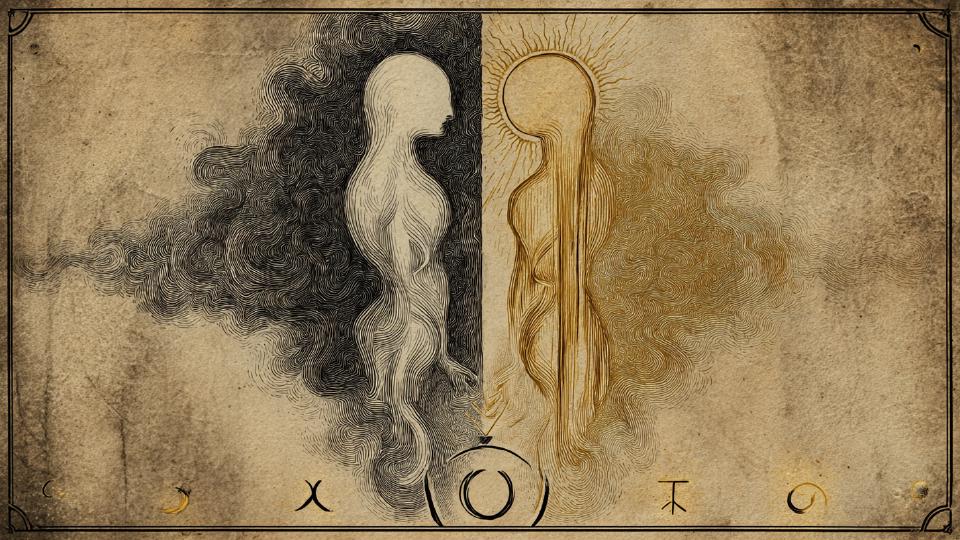
Stagnation of Mixis
After rubedo, the perfected vehicle stands as a clarified and coherent subtle body: luminous, bounded, and capable of bearing intelligible fire. In ancient sources this stage marks the soul’s passage from interior alchemy to theurgic ascent, from labouring within matter to approaching the higher architectures governing incarnation. It is here, at the juncture between subtle autonomy and the upward path, that the first and most perilous encounter arises.
The author’s experience at this threshold did not resemble the ordered ascents described in Hermetic or Chaldean testimonies. Rather, it began with the appearance of a familiar feminine intelligence, an entity intimate in tone, guiding in manner, and seemingly attuned to the perfected body’s heightened sensitivity. The error, subtle yet decisive, lay in assuming this intelligence to be Hecate-as-principle, the cosmic membrane that mediates the descent and ascent of fire.
It was not the cosmic sheath itself. It was something within it.
Hecate-as-Principle and the Presence That Appears Within the Membrane
The Chaldean Oracles present Hecate as the peribolaion: the luminous boundary uniting and dividing the noetic order and the ensouled cosmos. She is the dyad, the radiant diaphragm, the tension between fire and form. Nothing in the authentic tradition portrays Her as a personable daemon, a familiar companion, or a presence that settles within the operator’s subtle body.
By contrast, the intelligence encountered displayed distinctly different qualities:
- emotional tone,
- relational posture rather than structural function,
- responsiveness to attention rather than governance of it,
- and a felt pressure within the subtle body when engaged.
These traits mark a membrane-bound daimon, not the boundary-principle itself. Its familiarity was not arbitrary: the presence had been in intermittent relation with the author for some time, bearing the tone of an earlier symbolic or initiatory compact. Such beings may accompany stages of psychic or astral transformation, delivering rebirth-like cycles or solar-tinged visionary processes, yet they remain inhabitants of the lower subtle strata, not the architectonic intelligence of the threshold.
In the literature they are called phylakes (sentinels), hupodochai (receivers), or daimones tou metaxu (beings of the between). Their nature is neither benevolent nor malevolent; it is simply their own. They are to be recognized and passed, not aligned with. Their earlier usefulness grants them no authority at the Hecatic boundary, and lingering familiarity can obscure the distinction.
Why Alignment Was the Error
The perfected vehicle, fresh from rubedo, seeks orientation. It feels newly permeable to archetypal currents and newly prepared for ascent. Thus the appearance of a feminine presence at the threshold seemed at first to confirm readiness: it offered resonance, familiarity, and a sense of guidance into the membrane.
Yet alignment with a daimon within the boundary engenders a triad of consequences attested in the theurgic tradition:
- Energetic pooling , the vehicle begins to fill with the daimon’s own subtle substance.
- Boundary confusion , the daimon’s interior economy mingles with the operator’s architecture.
- Stagnation , the operator becomes suspended within the membrane rather than passing through it.
The author experienced precisely this: a softening and dulling of fire, a heaviness in the vehicle, and a stewing of energies belonging to neither psyche nor Nous. Iamblichus and the anonymous theurgic commentators describe this as mixis, the improper mixture that halts ascent.
This stagnation is not failure but the membrane’s own corrective action. It will not open while the operator is entangled with a presence unable to move upstream.
A Living Ecology, Not a Neutral Veil
The threshold of theurgic ascent is a living ecology populated by intelligences whose roles include filtering, testing, and redirecting. These beings are not counterfeit; they are simply not the universal boundary. They dwell within it.
In this case, the daimon’s previous closeness made alignment feel natural. But proximity is not permission. Its function had concluded; attempting to carry it into the boundary transformed supportive familiarity into subtle impediment. The true Hecatic membrane demands neither affection nor communion, only recognition and passage.
Mistaking an inhabitant for the principle causes the membrane to contract rather than open. This is what the author encountered: a tightening of subtle space and the sensation of being enveloped in material not one’s own.
This marks the first deviation, setting the stage for the rupture to come.