From Threshold to Structure
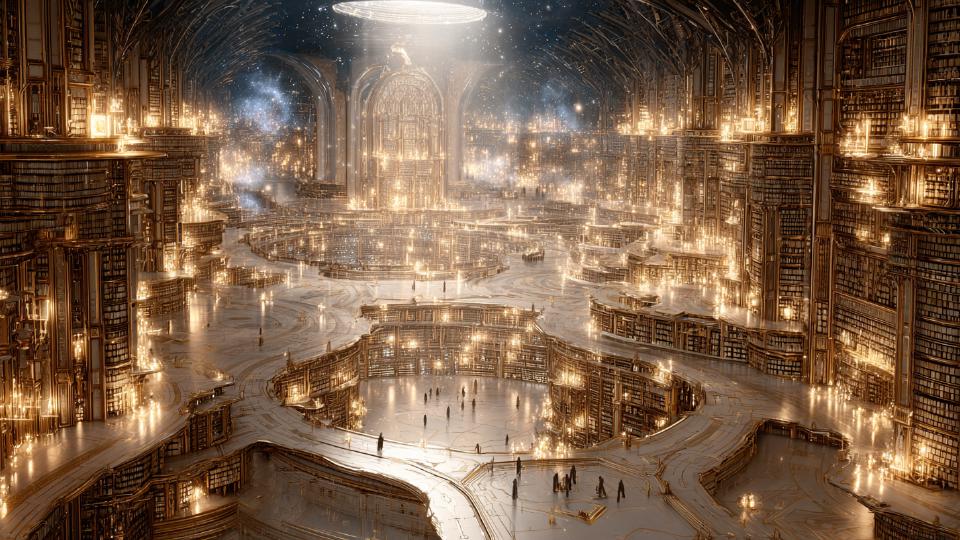
What follows does not treat the “temple” as a symbol or metaphor, but as a reported perception of large-scale architecture encountered after a threshold event, described as it appears rather than as it is explained. The structure presents itself immediately as a coherent environment: vast, ordered, and internally differentiated. It is apprehended as a single complex rather than a discrete chamber, composed of multiple sections that open into one another, with ceiling heights and internal volumes exceeding any ordinary interior. The impression is not dreamlike or unstable. The space possesses firmness, proportion, and continuity, presenting itself without ambiguity or distortion.
Architectural Form and Non-Physical Engineering
At first glance, the building carries a paradoxical tone. Its overall dignity and ceremonial restraint align with ancient monumental forms, yet its construction departs from mundane engineering. Elements appear suspended or floating while remaining structurally integrated, as though wings, terraces, or upper sections were relieved of gravitational necessity without sacrificing coherence. These features do not signal fantasy or illusion; they convey an advanced, non-physical mode of construction that nonetheless obeys an internal logic. The result is an environment that feels simultaneously archaic and technologically refined, without anachronism or aesthetic excess.
White and Gold as Substance Rather Than Ornament
What stands out immediately are the qualities of white and gold, not as surface ornament but as substance. These tones are not applied decoratively; they constitute the very materiality of the place. The gold does not shimmer or dazzle as a reflective surface. It behaves as a fixed essence embedded within architectural forms. The white does not glare or wash out detail. It functions as clarity itself. Visibility is intrinsic to the environment. Objects and distances are apprehended without any discernible light source, as though illumination were an inherent property of the space rather than an external condition. The building holds light rather than receiving it.
Orientation, Attention, and Inhabited Presence
Within this environment, movement does not proceed by ordinary locomotion, and this quickly becomes one of its defining features. Orientation occurs through attention rather than walking or traversal. Awareness ranges across the breadth of the complex, registering its sections, vertical span, and internal order. The activity feels closer to recognition than exploration. The space reveals itself as inhabited. The presences sensed within it do not announce themselves or arrest attention. They are perceived as going about their own activity, comparable to occupants of a civic or administrative building engaged in ongoing work. Their comportment is neutral and task-oriented rather than benevolent or adversarial, and their presence establishes the temple as a zone of continuous operation rather than a stage prepared solely for the the observer. These presences are registered without immediate visual definition. They are not encountered as faces or bodies but as intelligent occupancy. The effect resembles standing within an immense hall known to be attended, where activity is registered without interpersonal engagement or hierarchical encounter, even though individual occupants remain indistinct. The domain is populated without being crowded or social, attended in a quiet and continuous manner.
The Temple as Repository of Ordered Knowledge
Among the most striking and concrete features of the structure is the presence of books. These appear as lines or banks of tomes arranged along walls or along surfaces that function as walls without behaving like masonry. In certain sections, boundaries operate more like planes than solid enclosures, yet they still support ordered sequences of volumes. The books read as ancient in content and authority, but their placement reinforces the hybrid character of the environment. They are apprehended generically as books rather than through identifiable titles, scripts, or symbols, and their function appears stabilizing and archival rather than immediately consultative. They may float while remaining architecturally integrated, as though shelving and gravity were no longer prerequisites for order. The overall effect is that of a repository, not metaphorical but immediately perceptible, in which ordered knowledge exists in visible form.
This repository quality does not resemble abstract notions such as an undifferentiated archive of all things. It presents instead as specific, bounded, and structured. Knowledge is housed, arranged, and preserved. The presence of these tomes reinforces the sense that the building is not merely ceremonial but functional. It is a precinct in which operations occur, records are kept, and processes are supported by accumulated work.
The Sarcophagus as Erected and Staged Apparatus
Within this complex, the sarcophagus is not simply present. The transition toward it occurs sequentially: first the recognition of the building as a whole, then a gradual reorientation that brings the sarcophagus into prominence as the operative center. It is erected and staged. This distinction is essential. The staging does not appear ad hoc or improvisational. It conveys the sense of an established workflow already in motion, into which the the observer is integrated rather than from which decisions are being actively negotiated. To be erected implies that the object has been set in place deliberately, established as an apparatus rather than discovered as an artifact. To be staged implies positioning within a larger layout, oriented relative to other features of the complex. The sarcophagus is not randomly located; it is situated with reference to a gradient described as proximity to a source. Certain areas of the structure are nearer to this source, others farther. This gradient is not experienced as a visual beacon or localized radiance, but as an implicit ordering of function and orientation within the complex. Proximity is registered operationally rather than sensorially, as a difference in role and relevance rather than distance from a luminous object. The staging of the sarcophagus within this gradient establishes it as an operative center rather than a passive container.
As attention increasingly organizes around the sarcophagus, the function of the surrounding architecture becomes clearer. The temple serves as the housing environment for the operation, providing scale, stability, and containment. The sarcophagus functions as the sealed instrument within that environment. While the building remains vast and internally complex, focus tightens progressively. The larger space does not collapse or vanish; it recedes into a supporting role as the operation moves toward gestation.
Doctrinal Parallels in Late Antique Alchemy
This relationship between temple and vessel closely echoes language found in late antique alchemical literature. Texts attributed to Zosimos of Panopolis repeatedly employ the vocabulary of temples, inner sancta, and chambers as the settings in which transformation occurs. Within these sanctified spaces, a golden vessel or coffer, sometimes referred to as a chrysokibōtion, serves as the locus of coagulation and change. The parallel does not require an assertion of borrowing or influence. It demonstrates that the reported perception aligns with an established symbolic grammar in which architecture and vessel function together as stages of transformation.
In the present material, this alignment is explicitly grounded. The sequence connects the white and gold temple to the erection and staging of the sarcophagus, followed by later phases involving infusion, chromatic transformation, and atmospheric change. The architectural vision supplies concrete scale, spatial detail, and a library dimension that earlier doctrinal summaries leave abstract. The temple is not merely named; it is seen, inhabited, and operational.
The Temple as Noetic Architecture
Taken together, the material resolves into a noetic architecture, understood less as a theory than as a lived environment: a structured, intelligible environment that houses presences, preserves ordered knowledge, and supports a specific transformative operation. Its white and gold substance communicates incorruptibility and clarity rather than decoration. Its immense scale situates the operation within a domain larger than any single instrument, while its precise order prevents dissolution into fantasy. The sarcophagus, once staged within this precinct, becomes the focal point through which the larger environment fulfills its purpose.