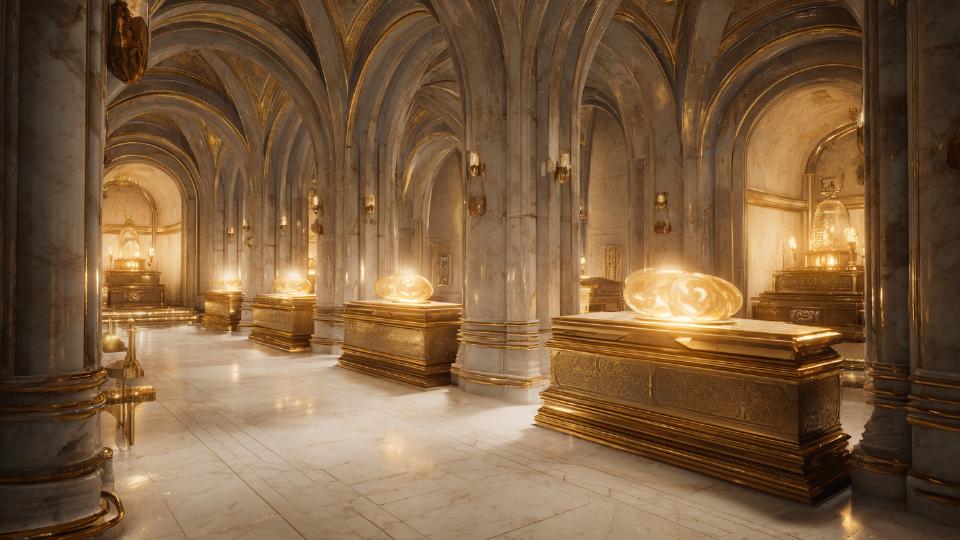
Gestation in the Gold Coffin
Beyond the gateway, within the vast noetic edifice, the operation contracts from an expansive condition of presence into a single, deliberately prepared center: the sarcophagus. The shift is structural rather than dramatic. What had first appeared as immersion in an architectural totality is now gathered into a precise locus intended to receive, contain, and stabilize transformation. The sarcophagus does not arise spontaneously within the field. It is erected, positioned, and deliberately staged within the white-and-gold precinct, then placed further inward, nearer to source, as the work intensifies. Its situation marks it as an instrument embedded within an already ordered noetic architecture, not as an isolated object suspended in abstraction.
Gold as Substance and Condition
The sarcophagus is apprehended as gold in a strict and non-ornamental sense. This gold is neither decorative nor reflective, nor does it signify wealth or reward. It denotes incorruptibility, fixity, and resistance to dissolution. Gold functions here as a condition of being rather than an aesthetic surface. The form of the sarcophagus bears a double character. It is at once coffin and vessel: a sealed container fashioned for a precise and demanding operation. The surrounding environment participates in the same white-and-gold register that defines the larger noetic structure, yet the sarcophagus concentrates this quality. The distinction is not one of kind but of density, comparable to the difference between the body of a temple and its most consecrated interior focus.
Assent and Sealing
At the threshold of the sarcophagus, the operative requirement is neither inquiry nor interpretation. The decisive act is assent. A moment of verification establishes readiness and stability, after which the work advances only through consent. This assent is neither emotional nor analytical. It is a simple yielding that permits enclosure. Once given, sealing begins. The operation proceeds not by manipulation or exertion, but by allowing the container to close and to hold what has been entrusted to it.
Containment and Identity of Vessel
With the commencement of gestation, experience is governed by containment. The sarcophagus is not merely an enclosing structure situated within the noetic precinct. Simultaneously, the physical body itself is apprehended as having become the gold vessel. The coffin exists both as an external structure and as an internalized condition. Flesh assumes the function of containment. This convergence is essential. The work depends upon the dissolution of any meaningful distinction between vessel and occupant. Remaining within the seal, preserving coherence, and allowing fixation to proceed constitute the entirety of the operative stance during this phase.
Gestation and Fixation
What unfolds within the sarcophagus is best described as gestation. It is a prolonged state in which death and rebirth coincide without spectacle. There is no sequence of events in the conventional sense, no accumulation of images, and no narrative progression. The intensity of this phase lies in sustained stillness and pressure. Transformation occurs through fixation rather than movement. Noetic fire is sealed within the vessel and held there until stability is achieved. The sarcophagus functions simultaneously as womb and tomb, a space in which dissolution and reconstitution are inseparable aspects of a single process.
It is important to note that fixation does not immediately yield clarity or expansion. The sealing establishes a new ratio within the operative subject, but that ratio must later be redistributed across psychic and corporeal layers. The stillness of gestation therefore precedes, rather than guarantees, subsequent coherence.
Integration of Nous, Soul, and Daimon
The purpose of the sealed phase is integration. Nous, soul, and daimon are not approached as separate agents to be invoked or addressed. They are folded inward into a unified operative consciousness. The daimon, in particular, is not encountered as an external figure, but incorporated as an internal principle. This integration requires noninterference. Any attempt to direct, hasten, or interpret the process would compromise fixation. The identity of container and contained ensures that the work proceeds as an internal consolidation rather than as an exchange between distinct entities.
Indications of Completion
Although the sarcophagus phase is marked by visual austerity, specific signs indicate the approach of completion. These signs do not interrupt containment but arise from within it. Gold is perceived as infusing the body, with particular emphasis upon the organs of sight. At the same time, the surrounding noetic atmosphere begins to shift away from the white-and-gold register toward deep blue and violet. These changes signal movement from sealed gestation toward emergence. After prolonged stillness, they constitute the first differentiation within the field.
Emergence Without Re-Entry
Completion of the sarcophagus phase does not result in repeated enclosure. The noetic architecture in which the sarcophagus was situated remains accessible, but the coffin itself does not reappear as an operative site. This distinction is critical. The sarcophagus is conditional, not permanent. Once fixation is achieved, containment is no longer required. What was once an instrument becomes a background condition.
Return to the noetic structure after gestation occurs without sealing. The subject no longer enters a vessel but stands within the same ordered field as a stabilized participant. Knowledge is no longer received through pressure and enclosure, but through direct participation in the noetic order. This shift marks the end of gestation proper and the beginning of post-fixation consolidation.
Embodiment After Fixation
Fixation does not complete embodiment; it enables it. Following emergence, a period of redistribution and adjustment often ensues, in which the newly stabilized noetic condition begins to impose a different proportion upon psychic and physical layers. This phase is characterized not by new operations, visions, or symbolic actions, but by gradual harmonization. Attention, appetite, and comportment recalibrate as the body is educated by the fixed noetic ratio.
This process does not reopen dissolution, nor does it require further containment. It is a continuation of the work under different conditions: not transformation, but consolidation.
Traditional Correspondence and Lineage
The configuration of the sarcophagus belongs to a well-attested lineage within late antique and early medieval theurgical and alchemical literature. The closest parallel is the chrysokibōtion of Zosimos of Panopolis, the golden vessel or coffin in which spirit is fixed into body and body rendered capable of receiving spirit. In Zosimos’ accounts, the work proceeds not through ascent or ecstatic flight, but through enclosure, sealing, and endurance under pressure. The vessel is the site where death, corruption, and reconstitution coincide as a single operation.
The same principle appears in later Western sources under different names. In the Aurora tradition associated with Thomas Aquinas, wisdom is gained through prolonged containment and patient coction rather than through visionary proliferation. Jacob Boehme repeatedly describes the rebirth of the inner human as occurring through enclosure within the divine ground, where fire and light are held together until a new form can emerge. The Chaldean theurgic tradition likewise emphasizes stability, purity of assent, and the consolidation of the divine principle within the operative subject, rather than dialogic engagement with external powers. Across these sources, the work is framed as internal consolidation under sealed conditions.
The sarcophagus thus stands within a continuous symbolic grammar. It is the tomb of dissolution, the womb of gestation, and the furnace of fixation at once. Its gold signifies not illumination or reward, but the condition of incorruptibility required for integration. What is enclosed is not an image or a summoned presence, but the operative subject itself, rendered capable of bearing noetic fire without dispersal.