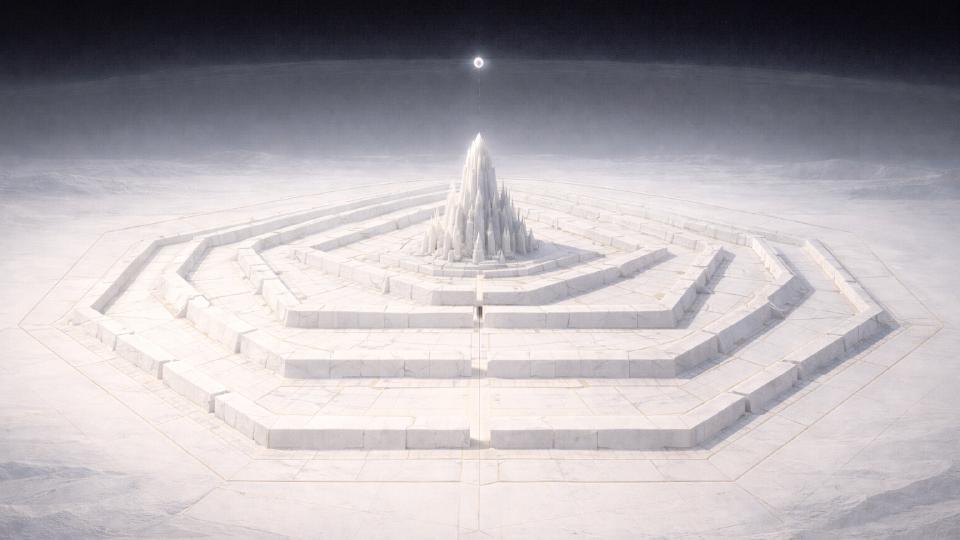
Fortress of the Mind
This post concludes a retrospective reconstruction of visionary operations, shaped through the careful re-reading of earlier notes. The order of events is preserved as recorded, while the presentation has been arranged for clarity and momentum. Explanatory remarks remain secondary, offered only where they help the symbols and operations read cleanly.
These final scenes are treated as operations rather than private reverie. The emphasis remains on changes of regime and function: shifts in atmosphere, the method of approach, the progressive simplification of movement, and the passage from navigation to translation.
Summit Shift into Noeric Simplicity
A decisive change takes place in the field itself. The earlier atmosphere of gold and orange, with its choric movement and collective current, gives way to whiteness: calm, indistinct, and largely without texture. The difference is not merely visual. It presents as a change of register, as though the medium of experience has been pared down to essentials.
A sense of summit accompanies the shift. Above lies a deep, dark stillness with the character of a “sky,” though not a familiar one. It presents as an edge or margin, a quiet boundary where distance, depth, and limit converge without emphasis.
At this point, individuality returns. The former condition of being carried as one among many in a choric current recedes. Operation becomes solitary again, not as deprivation, but as a clean re-localization of identity.
Ahead, a large geometric structure comes into view: tiered, walled, and carefully articulated. The relation to it is direct and unhurried. The structure stands present as a work to be met.
This shift reads as movement from a luminous, choric order into rarefied simplicity, where individuality is recollected and attention gathers around a single, concentrated work of approach.
Entry and Tier-Work around the Polygonal Citadel
The structure presents as concentric and gated, yet distinctly polygonal rather than round. It suggests a citadel or fortress-like complex, tier upon tier, each layer defined by wall, edge, and threshold.
The gate responds to state. Hesitation meets resistance, not as punishment, but as a mirror. When steadiness is present, entry occurs naturally. The opening presents as a consequence of alignment rather than an act of force.
Inside, direct inner “doors” appear to offer passage straight toward the center through successive layers. The movement taken is different. Rather than proceeding by direct penetration, each tier is circumambulated. The perimeter is traced slowly as a deliberate circuit, mapping the boundary, pausing, and allowing stillness to register as a real condition rather than an idea.
As the center draws nearer, movement changes again. The path becomes dual. Motion divides into two complementary halves that circle in opposite directions and then rejoin. On the next tier, the same pattern repeats, but the initial direction reverses. The effect is not confusion, but balance: a symmetrical working of opposition that resolves into a single line.
This tier-work emphasizes comprehension by degrees. The approach is not a rush to the center, but a measured integration of each layer’s stillness, with dual motion functioning as a controlled reconciliation of complementary currents.
Completion of Tier Integration and Readiness at the Inner Threshold
The circumambulation pattern completes through progressive simplification toward the center. Each tier reduces complexity. Movement becomes quieter and more economical. The citadel remains calm throughout: present, non-coercive, not beckoning. A steady quality of awaiting persists, as though readiness is the condition being established rather than a prize being granted.
What might ordinarily be rendered as emotion appears instead as adjustment. The interior register shifts and settles. The event is not affective in the usual sense. It is energetic settling: a fine rebalancing of the whole toward stability.
Readiness is present at the inner threshold, not as triumph or climax, but as a clean condition: the completion of a work of approach.
This phase reads as the sealing of the tier-work: integration completed not by excitement but by quiet consolidation, with the threshold held in stillness rather than crossed by impulse.
Detachment and Draw toward the New Upper Limit
From the citadel or tower complex, detachment occurs and localization shifts. The operator is no longer situated as a moving figure within tiers, but as a sphere.
The sphere is then drawn away, carried off by floating translation rather than by navigation. No further tier-climbing occurs; no perimeter-work resumes; no directional seeking appears. Movement occurs as a pull, as though the domain of the citadel has completed its function and releases what it has prepared.
Translation proceeds toward a new limit above: another boundary, another edge or constraint beyond the citadel’s jurisdiction. No new landscape is described. What comes into view is boundary itself, approached as a condition rather than a place.
The operation here is not exploration but transfer: release from the completed structure and a drawing toward the next upper limit, where a new constraint defines the next mode of work.