A foundational essay on motion, coherence, and the movement of the soul toward the Good.
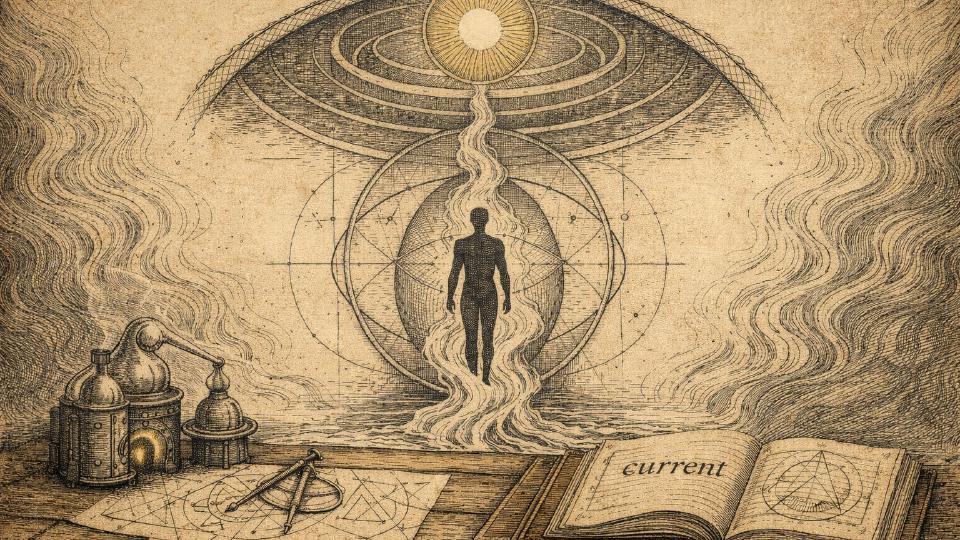
Preface: This is the first post in the Current series, which turns directly to movement as a practical question rather than only a metaphysical one. The new book, Current, addresses this in a more applied way. See the book description here: Current on Amazon.
The short version
Most accounts of motion stop with the physical world. Bodies move, forces act, and things change place. Yet the traditions that shaped much of classical and medieval thought rarely stopped there. They assumed that what appears as motion in the visible world is only the most outward expression of a deeper and more pervasive pattern.
In older metaphysical and esoteric traditions, motion refers not only to the displacement of bodies but to the unfolding of beings, the shifting of consciousness, and the gradual participation of the soul in what is highest and most real. Maximus the Confessor gives this insight a rigorous theological articulation. Hermeticism, theurgy, and alchemy approach the same structure through cosmology, symbol, and practice. When placed beside one another, they reveal a shared intuition.
Everything moves, but not everything moves in the same way.
Material things move through space and time. The soul moves through attention, desire, and understanding. Consciousness moves through symbol and participation. Spiritual life moves through increasing alignment with the Good. Once that distinction becomes clear, a number of traditions that are usually treated separately begin to illuminate one another.
This is the central claim of the discussion that follows.
Why this matters
Seeing motion in this broader sense changes the way spiritual life is understood. Growth no longer appears accidental, nor is confusion merely a private psychological disturbance. Coherence, insight, symbolic practice, and moral development begin to look like different forms of movement within an ordered reality.
Practices such as contemplation, alchemical symbolism, or pathworking cease to be isolated curiosities. They become intelligible as attempts to guide and refine movement in the subtle dimensions of human experience.
Once this perspective is adopted, a more searching question emerges. Which kinds of motion deepen alignment with reality, and which lead toward fragmentation or illusion? The answer to that question quietly governs everything that follows.
The key insight from Maximus
Maximus the Confessor begins from a simple but far-reaching observation: creation is not static. Every being exists in a state of unfolding. What something is cannot be separated from the direction in which it tends.
This direction is expressed through what Maximus calls a logos, an inner principle of meaning placed within each created thing. The logos of a seed inclines it toward the mature form of the tree. The logos of the human mind draws it toward truth. The logos of human life directs it toward goodness, communion, and participation in divine life.
Movement, in this sense, is not an accident of existence but its normal condition. Creation moves because it is unfinished.
The crucial distinction therefore does not lie between motion and rest. It lies between ordered and disordered movement. When a being unfolds according to the principle placed within it, its motion becomes coherent and fruitful. When that orientation is lost or distorted, motion continues but becomes fragmentary.
This insight allows change to retain its dignity without assuming that every movement is trustworthy. Life always moves; the question is whether it moves in accordance with its deeper order.
A simple map of the whole argument
The whole tradition may be grasped through four linked ideas.
1. Reality is structured
Things are not random. They unfold according to intelligible patterns.
2. Motion is lawful
Every real transformation follows an order proper to its nature.
3. Knowledge is participatory
The deepest knowing comes through alignment, not detached observation alone.
4. Coherence is the sign of right movement
Ordered motion gathers, integrates, clarifies, and strengthens. Disordered motion scatters, divides, and confuses.
Once these four ideas are in place, Maximus, Hermeticism, theurgy, pathworking, and alchemy begin to illuminate one another.
What “lawful motion” really means
Lawful motion does not mean rule-following in a shallow or moralistic sense. It means movement in accordance with the structure of reality.
In Maximus, this lawfulness is grounded in the logoi. Each being carries its own principle of order and fulfillment. When it moves in accord with that principle, it becomes more fully itself. When it moves against it, disorder appears.
This same idea appears in alchemy in a different language. The art does not truly work by violating nature. It works by cooperating with nature, purifying and accelerating processes already latent within matter. Traditional alchemical texts are emphatic on this point: the work must proceed with nature, not against it.
This idea bridges theology, metaphysics, and esoteric practice. It explains why flourishing is not arbitrary and why genuine transformation deepens reality instead of distorting it. Spiritual methods lose their power when they are severed from the order they are meant to follow.
Motion does not mean the same thing in every realm
Difficulty often arises because the same word is used for very different kinds of activity. Motion in the physical world refers to displacement through space. Motion in the life of the soul refers to transformation of awareness, understanding, and orientation. The term remains the same, but the medium in which the movement occurs changes.
Recognizing this distinction allows older metaphysical language to regain its clarity.
Physical motion
Physical motion is the most obvious form. It means movement through space, material interaction, visible change, and measurable force.
This is the kind of motion modern habits of thought recognize most easily.
But it is only one form.
Psychic or imaginal motion
In the subtle life of the soul, motion happens through shifts of attention, feeling, symbolic form, and interior orientation.
A person can move from fear to courage, from confusion to clarity, from inner division to alignment. No bodily travel is required, but something real has changed.
Intellectual motion
The mind also moves. It moves by understanding, by ascent into intelligibility, by perceiving deeper order.
In this sense, learning is not just accumulation. It is movement into a wider field of coherence.
Spiritual motion
At the highest level, motion becomes participation. The soul moves toward the Good by becoming more aligned with truth, goodness, and divine life.
This is where Maximus becomes especially important. For him, the highest motion is not locomotion but deification: creaturely participation in divine life.
A clearer comparison of physical and subtle motion
A brief comparison helps make the distinction concrete.
Physical motion is movement through place. Psychic motion unfolds as shifts of attention, emotion, and interior orientation. Imaginal motion occurs through symbolic form, the language of vision, myth, and ritual. Intellectual motion proceeds through understanding as the mind advances toward greater coherence. Spiritual motion, in the fullest sense, is movement through participation in the Good.
Seen in this way, the term motion becomes less mysterious. It refers to genuine processes of transformation occurring in different dimensions of reality.
Why Hermeticism belongs in this conversation
Hermetic traditions assume a cosmos alive with order, intelligence, and correspondence. The world is not dead matter. It is a meaningful whole. Transformation is therefore possible because the levels of reality are related.
In the Corpus Hermeticum, ignorance is repeatedly treated as one of the great human afflictions, while knowledge of divine reality restores orientation and life. This is already a language of motion: consciousness can descend into forgetfulness or ascend into knowing.
The Hermetic worldview also treats change as transformation rather than annihilation. Things pass, alter, recombine, and unfold within a living cosmos rather than simply vanishing into nothingness.
That makes Hermeticism a natural companion to Maximus. Both see reality as intelligible. Both see human beings as capable of ascent. Both see fulfillment as tied to participation in a deeper order.
What Maximus states theologically, Hermeticism often stages cosmologically.
Gnosis: not secret information, but recovered orientation
The word gnosis is often flattened into “hidden knowledge.” That is too small.
In the strongest sense, gnosis is participatory knowing. It is what happens when perception, life, and reality begin to align.
This matters because it changes what knowledge means.
In this framework, the Good is not truly known by definition alone. It is known through attunement. Justice is known by becoming just. Truth is known more deeply as consciousness becomes ordered to truth. The soul sees more clearly when it is less divided.
That is why gnosis is directional.
It is not possession of data. It is a movement out of estrangement and into intelligible relation.
Put more simply, gnosis is what it feels like when the soul regains its compass.
And once that is said, coherence becomes easier to recognize.
Coherence: the practical sign that motion is right
If lawful motion is the principle, coherence is often the most practical sign.
Coherence means that the parts begin to hold together.
In human terms, it means that desire starts to align with understanding, understanding starts to align with truth, and action starts to align with what is genuinely good.
When that happens, life gains force, clarity, and direction.
Fragmentation produces the opposite. Thought goes one way, desire another, action a third. Energy leaks. Attention diffuses. Meaning weakens.
Coherence therefore becomes a practical indicator of alignment. In Maximus it signals harmony with the Good. In Hermetic thought it reflects restored participation in cosmic order. In alchemy it appears as the transition from mixture and confusion toward conjunction and stable integration.
A useful test follows from this:
right motion tends to increase coherence.
If a path produces only fascination, intensity, or self-enclosure while increasing fragmentation, it may be dramatic, but it is not necessarily true.
Why pathworking is more than imagination
Pathworking becomes much easier to understand once subtle motion is taken seriously.
A pathworking is not simply a colorful fantasy exercise. At its best, it is a disciplined way of moving through symbolic space in order to reorganize consciousness according to meaningful patterns.
That matters because it shifts pathworking from ornament to method.
That happens in several ways.
1. It gives the soul a map
The symbolic environment of a pathworking, whether temple, ladder, garden, planetary sphere, cave, or ascent, provides a structure. It gives consciousness a pattern to move within.
2. It stabilizes attention
Attention is one of the main vehicles of subtle motion. A pathworking gathers otherwise diffuse awareness and directs it through a sequence.
3. It teaches through form
Images are not decorative extras. In older traditions, they are carriers of order. The soul learns how to move by moving through ordered symbols.
4. It can change participation
If the symbols are lawful and the practice is sound, the result is not mere entertainment but a real shift in orientation, feeling, and understanding.
So pathworking can be understood as guided motion in the imaginal realm.
Its legitimacy depends not on novelty, but on whether it produces greater coherence, alignment, and intelligible transformation.
Theurgy and the logic of higher alignment
Theurgical traditions make this even clearer.
In Iamblichus, ritual does not work because human beings force divine realities to respond. It works because reality is hierarchically ordered, and symbols, materials, and rites can participate in higher principles when lawfully used.
This is another form of motion by participation.
The rite becomes a site where lower and higher levels of reality are brought into alignment. What matters is not personal assertion, but correspondence.
That is why theurgical motion is best understood as resonance rather than coercion.
Again the pattern is the same. Reality is ordered. Movement occurs through participation. Efficacy depends on lawful alignment.
Alchemy: the choreography of transformation
Alchemy may be the most vivid symbolic language for all of this.
Every major alchemical operation describes a kind of motion:
- calcination breaks down fixed form
- dissolution returns what is hardened to fluid potential
- separation distinguishes mixed principles
- conjunction reunites on a higher basis
- fixation stabilizes what had been volatile
- multiplication intensifies attained order
Alchemy is compelling because it presents transformation as a sequence of intelligible operations. Each stage reveals how disorder can be separated, purified, and recomposed into a more stable form.
This is one reason alchemical language continues to grip the imagination. It does not merely describe change. It gives change a dramatic structure.
Boehme: a vision of reality as dynamic tension
Jacob Boehme adds another dimension that helps keep the whole subject alive.
His cosmology is dynamic from top to bottom. Reality unfolds through tension, polarity, contraction, expansion, fire, light, desire, and manifestation. The world is not a dead arrangement of finished parts. It is process, drama, and energetic becoming.
Boehme therefore reinforces the central theme: manifestation is dynamic, but the significance of that dynamism depends on the principles guiding it.
Logoi and Logos: the deepest metaphysical structure
Maximus becomes most powerful when the relation between the logoi and the Logos is brought into view.
Each created being bears its own logos, its own inner principle, pattern, and direction. But the many logoi are not isolated fragments. They are grounded in the one Logos, the divine source in whom their unity is held.
This changes the meaning of motion.
Beings do not merely move according to private destinies. Their movements belong to a larger intelligible harmony. The many unfoldings of creation are gathered in a deeper unity.
This is one of the great meeting points between Maximus and Hermetic metaphysics.
Reality is not merely structured.
Reality is structured in a way that can be known, participated in, and spiritually inhabited.
Deification: the completion of motion
The highest point in Maximus is deification.
This does not mean that the human being ceases to be human, or becomes identical with God in essence. It means that human life comes to participate ever more deeply in divine goodness, wisdom, and life.
Seen through the lens of motion, deification is the consummation of lawful becoming.
It is what happens when desire, knowledge, action, and being come into increasing harmony with the Good.
This is why the language of ascent matters. The soul is not trying to escape reality. It is moving into fuller participation in reality’s deepest source.
Hermetic ascent, alchemical perfection, and the Maximian doctrine of deification are not identical, but they converge around a shared intuition:
the end of the path is not mere stillness, but perfected participation.
For readers dipping in: five takeaways
For anyone skimming, the argument can be reduced to five essential points.
Motion is more than physical
Older traditions treat motion as a principle of being, not just locomotion.
Every realm has its own mode of motion
Bodies move through space. Souls move through attention and desire. Consciousness moves through symbol and understanding. Spirit moves through participation.
Right motion is lawful
Transformation is real when it accords with the structure of reality.
Gnosis is oriented knowledge
It is not hidden trivia. It is recovered alignment and deeper perception.
Coherence is the practical sign
If a path produces integration, clarity, and real alignment, it is participating in lawful motion. If it produces glamour without order, something is off.
The deeper synthesis
When Maximus, Hermeticism, theurgy, pathworking, and alchemy are read together, a remarkably unified picture appears.
Reality is dynamic.
Meaning is built into things.
Transformation is lawful.
Knowledge is participatory.
The subtle realms are real modes of becoming, not just decorative metaphors.
The deepest criterion of spiritual movement is whether it leads toward greater coherence with the Good.
That is the deeper reason the language of motion matters.
It gives a way to speak about theology, mysticism, symbolic practice, and transformation without reducing them to sentiment, abstraction, or spectacle.
It restores direction.
And once direction returns, many familiar practices begin to read differently.
Conclusion: the real contrast is not motion versus rest
The traditions considered here converge on a simple but demanding insight. The decisive distinction in human life is not between movement and stillness but between movements that gather and movements that disperse.
Disordered motion scatters attention, fragments desire, and weakens perception. Ordered motion gradually integrates the powers of the person and aligns them with what is real. This pattern appears in moral life, in contemplative practice, in symbolic disciplines such as alchemy, and in the metaphysical vision articulated by Maximus.
Maximus describes creation as moving toward fulfillment in the Good. Hermetic writers describe an ascent of consciousness through the levels of the cosmos. Theurgists speak of alignment with higher principles. Alchemists portray the same drama through the language of purification and recomposition.
Different vocabularies, yet the same intuition persists. To exist is to move. To flourish is to move in harmony with the deeper order of reality.
Frequently Asked Questions
What does Maximus the Confessor mean by motion?
For Maximus, motion is not limited to physical displacement. It also describes how the soul, mind, and whole person move toward their proper fulfillment through participation in the Good.
How is spiritual motion different from physical motion?
Physical motion is movement through space, while spiritual motion is movement in orientation, understanding, and participation. It concerns the soul becoming more aligned with truth, coherence, and divine life.