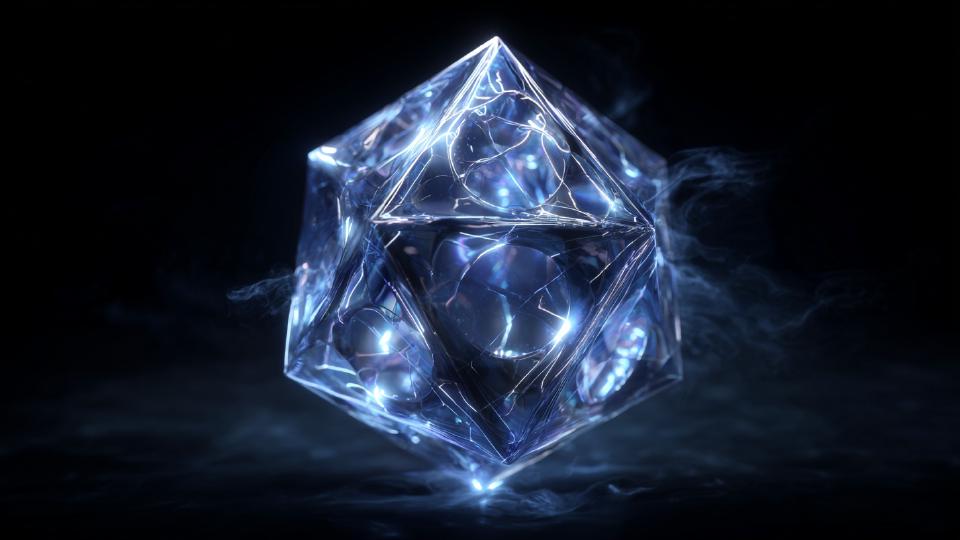
What Does the Icosahedron Mean in Sacred Geometry?
In sacred geometry, the icosahedron is associated with the element of Water. Its character is not stillness, but movement that holds together: flow, adaptability, dissolution, and continuity under change.
At its simplest, it expresses liquidity—something that receives form without keeping it. Yet this does not exhaust its meaning. The icosahedron presents a more exact condition: a structure in which change does not destroy coherence, but sustains it.
For the preceding airy phase of mediation and transmission, see octahedron meaning in sacred geometry. For a wider overview across forms, see the Sacred Geometry Hub.
The Classical Meaning
The icosahedron is one of the five Platonic solids and corresponds to Water.
This assignment is not decorative. Composed of twenty triangular faces, the form approaches the sphere. It neither settles like the cube nor directs like the tetrahedron. Instead, it distributes itself evenly in all directions.
Water behaves in the same manner. It holds together, yet does not hold shape. The form therefore expresses cohesion without fixity.
Geometric Logic: Loss of Direction
The defining feature of the icosahedron is the absence of a governing direction.
Its many faces shift orientation at every edge. No axis dominates; no base stabilizes. There is no single line along which force may extend. Movement cannot project outward in a privileged way and instead distributes across the whole.
Sphere, Dissolution, and Continuity
Of the Platonic solids, the icosahedron comes nearest to the sphere—the form of totality, equal in all directions.
Here multiplicity begins to smooth into continuity. What is discrete at one scale appears unified at another. In process terms, this marks the completion of the volatile phase: what was distinct becomes fluid, capable of recombination, yet not disordered. It is dissolution without collapse.
Forms can arise, gather, and dissolve again. They persist not as fixed objects but as configurations sustained by relation.
Center and Field
The icosahedron has a center, but it does not assert it. No axis leads to it; no face encloses it. The center is equally related to all sides and privileged by none.
For that reason the form is better understood as a field than a container. Within it, relations are maintained while forms shift. Patterns appear, reflect, and recombine. Nothing is held long enough to become fixed, yet nothing is lost if coherence is preserved.
Ordered Fluidity
This condition has two outcomes. With coherence, fluidity yields adaptability, continuity, and integration. Without it, the same fluidity becomes diffusion and loss of form.
If the octahedron mediates along an axis, the icosahedron mediates everywhere at once. There is no single passage; every point is transitional. It does not mark a crossing—it sustains a condition in which crossing is constant.
Working With the Icosahedron
Work with this form does not produce stillness. It produces continuity.
Let attention remain coherent without fixing on a point. Let breath be felt across the whole rather than along a line. Allow fluctuation, but do not let relation break.
The aim is simple: remain coherent without becoming fixed.
In One Sentence
If the octahedron organizes movement into transmission, the icosahedron represents coherence without fixed orientation.
Conclusion
The icosahedron represents Water: not merely flow, but coherence maintained through change.
It is the form in which structure begins to dissolve without disappearing, where multiplicity becomes continuous, and where identity persists without fixation.
It does not hold. It does not direct. It sustains—and in doing so, approaches totality without quite reaching it.
Frequently Asked Questions
What does the icosahedron mean in sacred geometry?
The icosahedron is traditionally associated with the element of Water. It represents flow, adaptability, cohesion without rigidity, and continuity under constant change.
Why is the icosahedron linked to Water?
In classical philosophy, especially in Plato’s Timaeus, the icosahedron corresponds to Water because its many faces create a near-spherical form, suggesting liquidity, cohesion, and the ability to assume form without fixing it.
What is the deeper meaning of the icosahedron?
Beyond its classical meaning, the icosahedron can be understood as a structure of continuous transformation, where identity is preserved through change rather than through stability.