What Does the Dodecahedron Mean in Sacred Geometry?
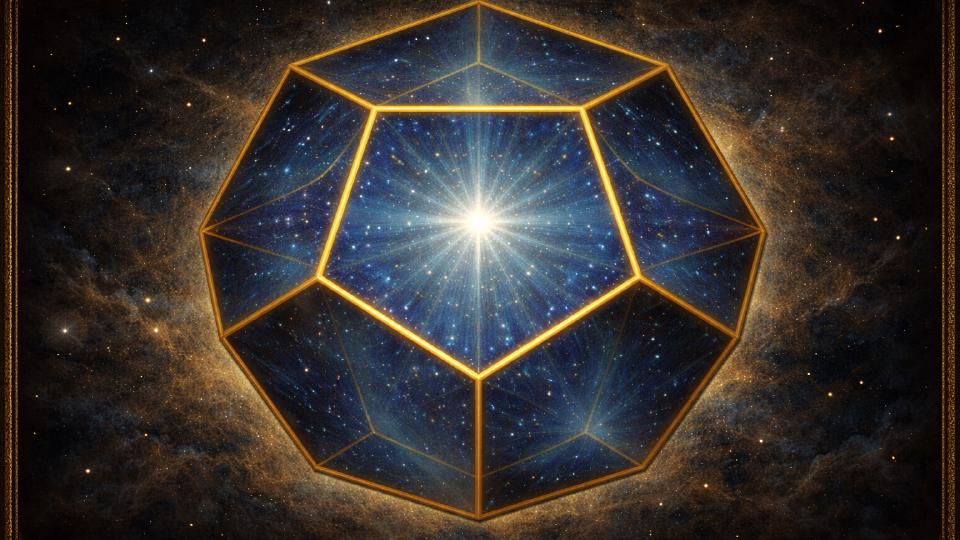
In sacred geometry, the dodecahedron is traditionally associated not with one of the four lower elements, but with the cosmos, the aether, or the fifth principle sometimes called quintessence. Its symbolism gathers around totality, intelligible order, and the relation between the part and the whole.
At its simplest, the dodecahedron signifies a world-like form: something ordered, complete, and permeated by proportion. Yet its deeper significance lies in integration. If the cube stabilizes, the octahedron transmits, the tetrahedron ignites, and the icosahedron sustains coherence through change, the dodecahedron gathers these modes into a more comprehensive order.
For the preceding watery phase of continuity and dissolution without collapse, see icosahedron meaning in sacred geometry. For a wider overview across forms, see the Sacred Geometry Hub.
The Classical Meaning
The dodecahedron is the fifth of the Platonic solids. In the classical tradition, it is commonly treated as the form used for the whole, rather than for one of the four elements.
This distinction matters. Earth, Air, Fire, and Water refer to conditions of manifestation and transformation within the world. The dodecahedron refers more readily to the order of the world itself: its intelligibility, its wholeness, and the pattern within which the elemental powers are contained.
For that reason, the dodecahedron is often linked with aether, heaven, or quintessence. It does not merely participate in process. It gives process a larger frame.
Geometric Logic: Why the Shape Matters
The dodecahedron consists of twelve pentagonal faces. This alone gives it a symbolic quality distinct from the other solids.
The pentagon and pentagram have long been associated with proportion, life, and harmonic relation. When pentagonal order closes into a three-dimensional body, the effect is neither the blunt settlement of the cube nor the fluid smoothing of the icosahedron. The form appears patterned, articulated, and expansive at once.
Its many faces prevent it from becoming overly directional. Yet unlike the icosahedron, those faces are pentagonal rather than triangular. The resulting impression is not only continuity, but articulated totality: a whole made from richly related surfaces rather than from simple repetition.
The geometry therefore suggests a world that is not merely unified, but meaningfully structured.
The Dodecahedron as Quintessence
Because the dodecahedron stands outside the four-element sequence, it is naturally read as the form of the fifth.
Quintessence in this sense is not a fantasy substance. It is the principle by which the elemental field becomes a cosmos rather than a heap. It is the binding order that makes multiplicity intelligible without erasing difference.
The dodecahedron belongs to that level. It does not replace the elemental forms. It comprehends them.
Where Fire initiates, Air mediates, Water coheres, and Earth fixes, quintessence orders their relation within a larger harmony.
World-Form and the Macrocosm
A fuller significance emerges when the dodecahedron is treated as a world-form.
In symbolic terms, it represents the condition in which local processes are recognized as expressions of a more comprehensive order. The part no longer appears self-sufficient. It is seen in relation to the whole that measures it.
This is why the dodecahedron readily takes on macrocosmic meaning. It suggests the zodiacal field, the patterned heavens, or the intelligible architecture in which becoming unfolds. These are interpretive extensions rather than a single fixed doctrine, but they arise naturally from the classical placement of the form.
The dodecahedron therefore belongs not merely to experience, but to orientation. It answers the question: within what larger order does this process occur?
Integration After the Elemental Sequence
Seen as a sequence, the Platonic solids can be read as distinct modes of operation.
The tetrahedron releases force. The octahedron carries it. The cube gives it body. The icosahedron preserves coherence through fluid transformation. The dodecahedron then appears as a further step: not another elemental condition, but the integration of conditions within a whole.
This makes the dodecahedron especially important in esoteric interpretation. It marks the point at which transformation is no longer understood only as a private or local event. The work is now measured against cosmic proportion.
To encounter the dodecahedral mode is to move from process to order, from sequence to system, from isolated transformation to correspondence.
Containment Without Imprisonment
The dodecahedron has an interior, but it does not feel prison-like in the manner the cube sometimes can. Its boundaries are too numerous and too subtly angled for that.
For that reason, it may be understood as a form of containment without blunt enclosure. It holds relation while remaining open in expression. It is ordered without appearing rigid.
This gives the solid a distinctive contemplative quality. It suggests a law that is alive, a structure that does not suffocate, and a wholeness that does not flatten the parts it includes.
In symbolic practice, this matters. The dodecahedron does not ask first for discipline, nor for release, nor for circulation. It asks for proportion: the fitting of each part into a wider order.
The Risk of Inflation
Like all higher symbols, the dodecahedron carries a danger.
Because it is associated with the whole, it may tempt the mind into premature totalization. One may imagine that seeing a pattern is the same as inhabiting it, or that glimpsing correspondence is the same as achieving integration.
The corrective is simple. True dodecahedral work does not abolish the lower forms. It presupposes them. Without the cube, there is no stability. Without the octahedron, no mediation. Without the tetrahedron, no catalytic transformation. Without the icosahedron, no continuity under change.
The greater order is not a substitute for formation. It is its comprehension.
Working With the Dodecahedron
In contemplative practice, the dodecahedron is best approached as a form of orientation to totality.
One mode of work consists in imagining awareness within a dodecahedral chamber and asking not what force is present, but how the present process belongs to a larger order. Attention is not driven toward intensity. It is widened toward proportion.
A second use belongs to correspondential thinking. A symbol, dream, or event is contemplated within the dodecahedral field so that its relations become clearer: above and below, inner and outer, part and whole. The aim is not free association, but disciplined recognition of pattern.
A third mode concerns integration after successful prior work. When a transformation has stabilized, the dodecahedron may serve as the form in which that change is situated within a life, a cosmology, or a longer initiatory sequence.
The essential gesture is always the same: not to intensify an isolated experience, but to place it rightly within the whole.
In One Sentence
If the icosahedron preserves coherence through change, the dodecahedron represents coherence understood as part of a larger cosmic order.
Conclusion
The dodecahedron represents cosmos, quintessence, and intelligible totality.
It is the form in which the elemental powers are no longer considered separately, but as members of a larger harmony. For that reason, the dodecahedron does not simply symbolize change, balance, or stability. It symbolizes their comprehension within the patterned whole.
Frequently Asked Questions
What does the dodecahedron mean in sacred geometry?
The dodecahedron is traditionally associated with the cosmos or quintessence. It represents wholeness, intelligible order, and the relation between the individual form and the larger pattern of the world.
Why is the dodecahedron linked to the universe?
In the Platonic tradition, the dodecahedron was treated differently from the four elemental solids. Its twelve pentagonal faces suggested a form fitted not to one element, but to the ordering of the heavens or the whole.
What is the deeper meaning of the dodecahedron?
Beyond its classical association, the dodecahedron can be understood as a geometry of integration, where stable form, movement, force, and continuity are comprehended within a larger, intelligible totality.